My Son Sanctuary Now Offering Multilingual Voice-over and Audio Guide Services
The My Son World Cultural Heritage Management Board launched a digital product titled “Multi-language voiceover – Audio Guide” on July 19 to provide visitors with information about the My Son relic site, according to a report by VOV.
The product is the result of a cooperation program between the My Son Cultural Heritage Management Board and VIETSOFTPRO Company, which has been in trial operation since June 19.
During the trial month, the digital product was used by 2,000 tourists to access information about the My Son relic site.
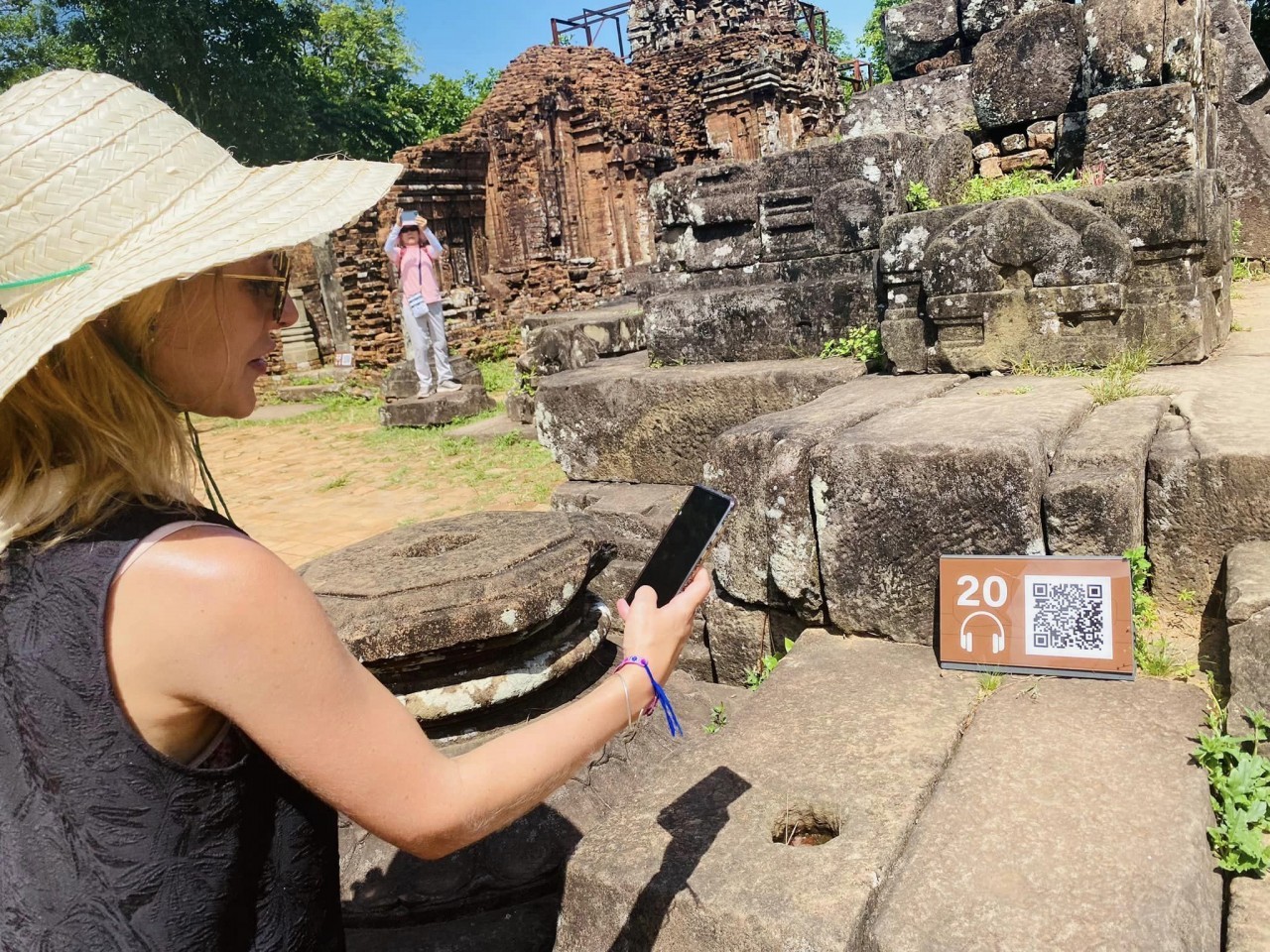 |
| Foreign tourists using the Multilingual Audio Guide (Audio Guide) to learn about My Son Sanctuary. Photo: Management Board of the My Son World Cultural Heritage |
Phan Ho, director of the Management Board of the My Son World Cultural Heritage, stated that the new product fully supports multi-language voiceover for various tourists, allowing them to listen to the auto-translations multiple times.
VIETSOFTPRO Company is currently working with the My Son World Cultural Heritage Management Board to add more languages to serve visitors, especially foreign tourists.
Ho added that in addition to the “Multilingual Voiceover – Audio Guide” digital product, thousands of artifacts at the relic site, along with the Sa Huynh – Champa Museum and My Son Museum, have been digitized. The Management Board is also implementing digital utilities for forest patrol and the management of the 1,158 hectares of landscape forest in the My Son cultural and historical relic area. The Board has also implemented administrative reforms and sells e-invoice tickets in accordance with Ministry of Finance regulations. Tickets can be paid via QR code and Visa card.
My Son Sanctuary, located in Duy Phu Commune, Duy Xuyen District, Quang Nam Province, is one of the main Hindu temples in Southeast Asia and Vietnam.
The tower temples in My Son are examples of Champa religious architecture. With a history of construction and continuous development spanning nine centuries, the temples showcase rich architecture and represent the grandeur and purity of Mount Meru in India.
Most of the temples and auxiliary buildings are built of brick using delicate techniques. The decorative patterns on the stone pillars, along with the round statues and sandstone reliefs, are carved based on Hindu myths.
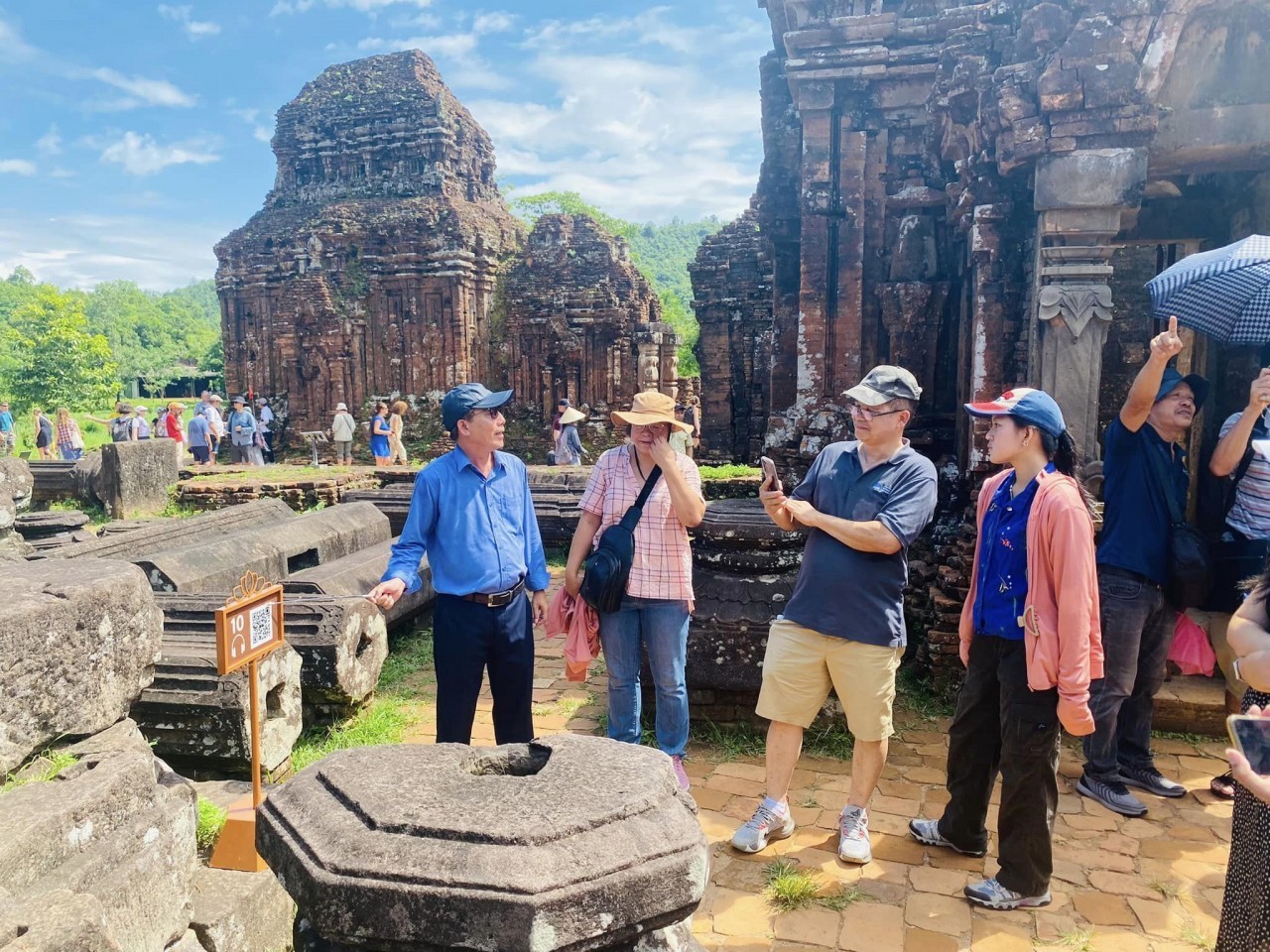 |
| Tourists can scan the QR Code to access information about the My Son relic site. |
The harmonious combination of sophisticated carvings on the brick walls outside the towers creates the beauty of the My Son temple complex, showcasing the distinctive features of Champa art.
During the 4th century, under the Bhadravaman Dynasty, My Son valley was selected as an important religious and belief center of the Champa kingdom.
In My Son, King Bhadravaman built temples for ceremonies and worship. The temple towers were constructed to commemorate great victories and conquests, and served as resting places for kings after their deaths. Their souls were believed to be gathered here with the gods of Hinduism, particularly the God Shiva who is considered the founder of the Champa kingdom.
At that time, the worship of the God Shiva, the creator and destroyer in Hinduism, was combined with the worship of the king at My Son. The first temple was built of wood and was dedicated to the god-king Bhadresvara, combining the name of the god Isvara (also known as Shiva) with the name of King Bhadravarman.
The maritime trade route between Champa and other medieval countries spanned nearly ten centuries, leading to the development of the Champa kingdom. As the number of tower temples increased, My Son became a significant site representing the brilliant and unique development of Champa art.
During the wars of the 11th century, the Champa kingdom and the temples in the My Son area were destroyed. King Harivarman V and Giaya Indravarman III built additional small temples in My Son. In 1149, Giaya Harivarman I ascended the throne, established a new capital in ViJaya (Do Ban, Binh Dinh), restored the temples, and built two large temples in My Son.
The subsequent king, Indravarman IV, did not build much but adorned the temple roofs with gold and silver. The amount of precious metal used amounted to 1,470 kilograms.
My Son Sanctuary holds an important spiritual position for the local community and served as a spiritual support for the ancient Cham people. It is a unique work of art that holds value to this day.
The post My Son Sanctuary Now Offering Multilingual Voice-over and Audio Guide Services appeared first on Vietexplorer.com.
View more from VietExplorer:
Hanoi to host BridgeFest Music Festival 2020Vietnam hands over two wanted criminals to US
Storm Molave causes damages in central region
Impressive photos taken by Vietnamese photographers at Aerial Photography Awards 2020
Some special wooden bridges in Vietnam
A visit to a 100-year-old house in Ha Nam
Some letting their guard down regarding COVID-19 prevention
Efforts made to search for storm victims
Hanoi creative space design contest launched
The majestic beauty of Dray Sap waterfall
Discover two fairytale mountain roads in Vietnam’s Northwest provinces
Unspoiled beauty in coastal ‘Fallen church’, northen Vietnam
Photo exhibition raises funds for poor children
World Teacher’s Day: An airline company offers free return flights for teachers
Rescuers work non-stop in search for landslide victims
Nghe An province evacuates residents as flooding worsens
Vietnamese Women’s Day (October 20): Best wishes and gifts to express thanks and affections
Covid-19 deals heavy blow to Vietnam’s inbound tourism in Jan-Oct
Co To island: A jade pearl of the northeast region
Foreign Minister holds talks with US Secretary of States


Comments
Post a Comment